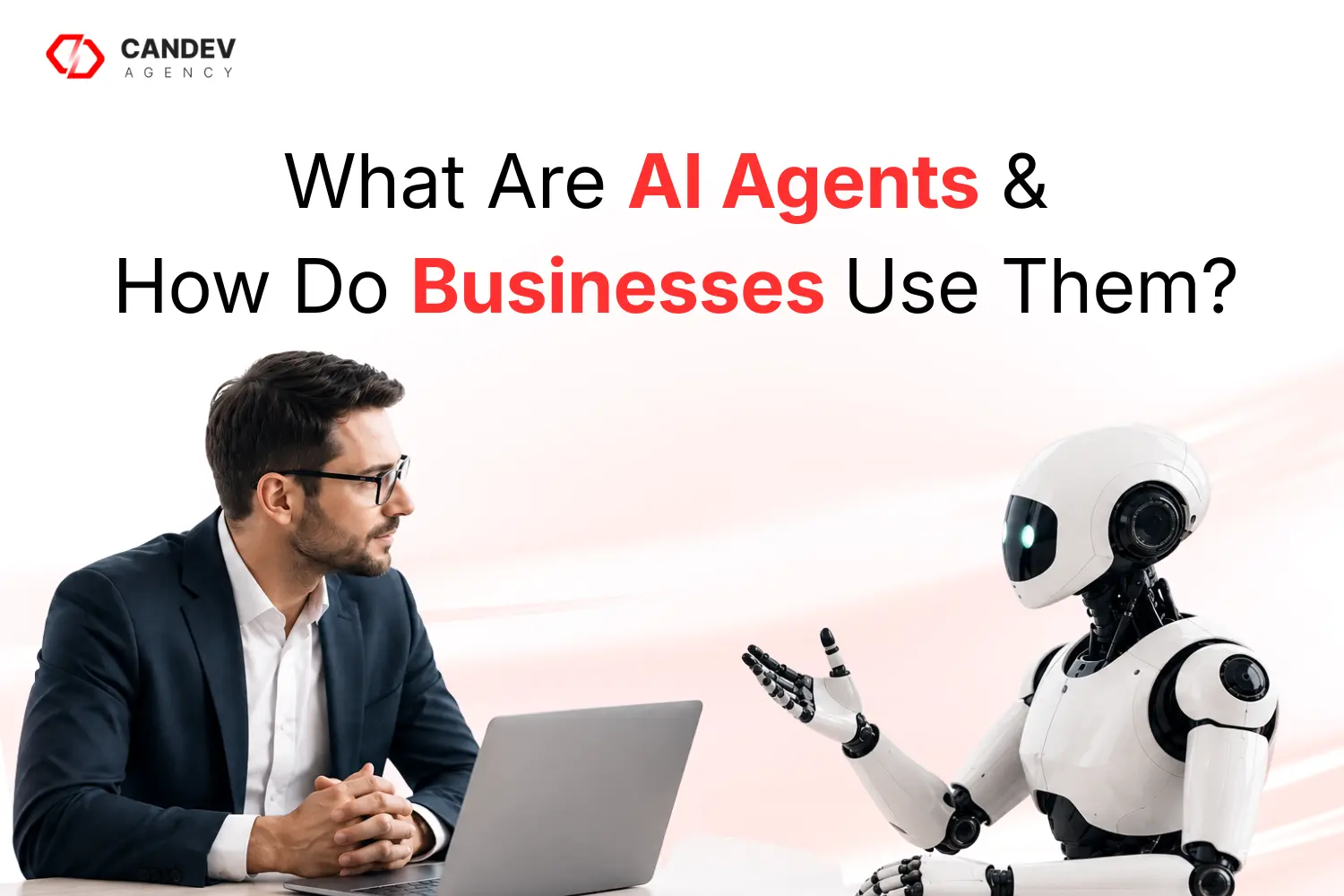
"AI agents" is one of the most talked-about terms in business technology this year. It's also one of the most confused. Some vendors use it to describe a basic chatbot. Others use it for something far more advanced. That mix-up leaves a lot of business owners unsure what they're actually paying for.
This guide clears that up. You'll get an idea of AI agents, see how they differ from regular chatbots, and learn where they actually make sense for a business in 2026.
What Is an AI Agent?
An AI agent is software built to finish a task on its own. It doesn't just reply to a message. It figures out what needs to happen, then does it using whatever tools it's connected to, like a CRM, a calendar, an inventory system, or a payment platform.
That's the key difference from older software. Regular programs follow fixed rules. Give them input A, and you always get output B. An AI agent works differently. It looks at the situation, picks a sensible action, and adjusts course if something changes partway through. Think of the difference between a script and an employee handling an open-ended task. That's roughly the gap between old software and an AI agent.
For example, picture a new employee who never needs to be told twice. You give them a goal, like "handle customer refund requests," and they figure out the steps on their own. They check the order, confirm the return policy, process the refund, and send a confirmation email. All of that, done. That's the basic idea behind AI agents.
This is very different from older software. Older software only does exactly what it's told, in the exact order it's told. AI agents can adjust when something changes, the same way a person would.
A few related terms get thrown around loosely, so let's define them:
Agentic AI describes systems built around this ability to decide and act, not just generate text or predictions.
Large language models (LLMs) are the technology like the models behind ChatGPT or Claude that often power the "thinking" part of an AI agent. They're what interprets your request and plans the next step.
AI automation is the broader category. It includes AI agents, but also covers simpler, rule-based automation that doesn't involve real decision-making.
AI Agents vs. Chatbots. What's the Difference?
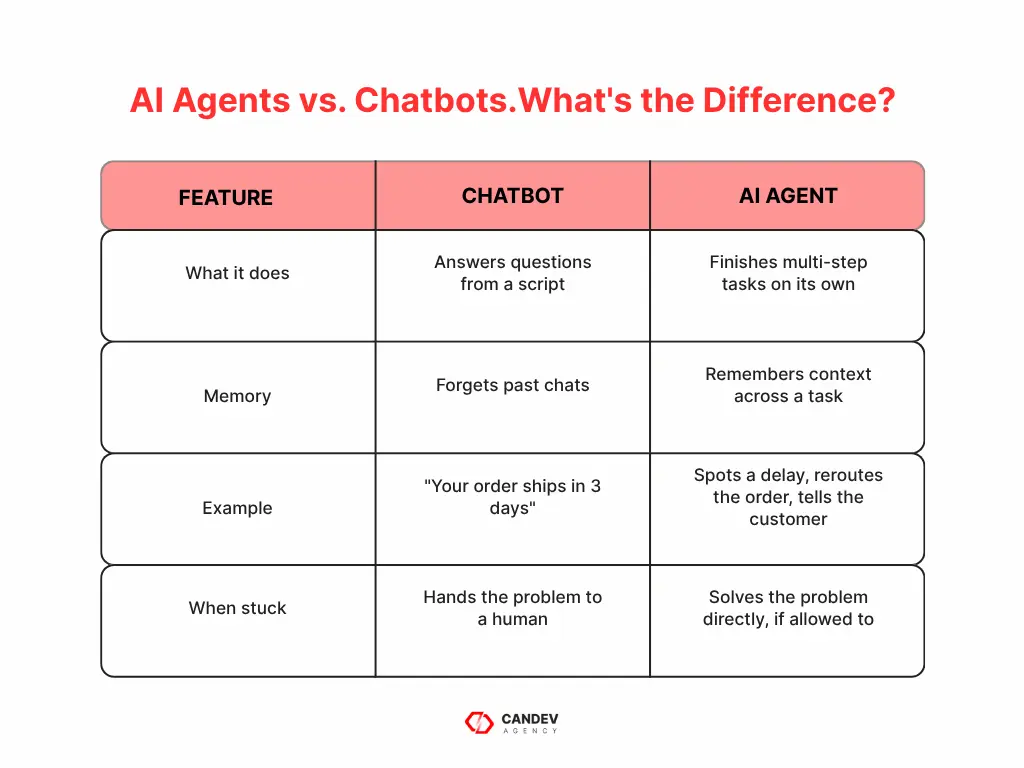
A chatbot works like a well-built FAQ page. It's useful, but only within the limits of what's already programmed in. An AI agent works more like a team member you've delegated a task to. Give it a goal, and it works out the steps and gets it done adjusting along the way as needed.
This is exactly why so many businesses are moving past basic chatbots and investing in real AI agents instead.
How AI Agents Work
You don't need a technical background to follow this. Most AI agents run through three steps:
Understand. The agent reads the request and figures out what result is actually needed.
Plan. It breaks the goal into a series of steps.
Act. It carries out each step through the systems it's connected to, checking the result before moving on.
If something goes wrong or the situation shifts, a well-built AI agent adjusts its plan instead of getting stuck. That's the whole point. It's built to handle real, messy tasks , not just follow one fixed script.
AI Agent Statistics: What Recent Research Shows
AI agents aren't just a talking point anymore. They're already in use, and the pace is picking up fast.
Gartner expects roughly 40% of enterprise applications to include a task-specific AI agent by the end of 2026. That's up from under 5% in 2025, an eightfold jump in a single year. McKinsey's State of AI 2025 report found that 62% of organizations are already experimenting with AI agents, and 23% have moved past testing into scaled, production use. Separate Google Cloud research on AI return-on-investment found that over half of surveyed executives said their companies were already running AI agents somewhere in the business, with average reported returns above 170%.
The takeaway is simple. AI agents have moved from "interesting experiment" to standard business tool, and fast.
Real Examples of AI Agents in Business
Customer service. A customer asks to return a jacket through an online store's support chat. Instead of waiting for a staff member, an AI agent checks the order, confirms it qualifies, starts the return, and emails a shipping label. Done in under a minute.
Sales. An AI agent follows up automatically with a lead who filled out a form last week. It answers a few basic questions and books a call directly onto the sales rep's calendar.
Operations. An AI agent watches inventory levels. When stock runs low, it reorders from the right supplier and flags anything unusual for a person to double-check.
Each of these follows the same pattern: a clear goal, a series of steps, and a finished task with no one typing instructions along the way. That's the real value here , hours of manual work handled automatically.
If you're wondering how this could work inside your own business, CanDev builds custom AI agent solutions that plug into the systems you're already using, rather than forcing a full technology overhaul.
Benefits and Limitations
AI agents offer real advantages, but they're not a fix for everything. Here's the honest picture.
Benefits:
Cuts down time spent on repetitive, rule-based work
Runs 24/7, not just during business hours
Reduces manual errors
Handles several requests at once without adding staff
Limitations:
Needs clean, well-organized data to work properly
Still benefits from human review on sensitive decisions
Not every task is a good fit for full automation
Needs real planning , a rushed setup usually causes more problems than it solves
The difference between a successful AI agent and a disappointing one rarely comes down to the technology itself. It almost always comes down to how well it was planned and built.
How to Start Using AI Agents in Your Business
You don't need to automate everything at once. Start small. Pick one repetitive task that eats up your team's time ,answering common questions, following up with leads, or updating records are good starting points.
Try it. See how it performs. Then expand to the next task once it's working well.
This is how most successful AI agent projects actually begin: small, focused, and built around a real problem , not chosen because it sounds impressive.
Ready to Put an AI Agent to Work?
If you're thinking about adding an AI agent to your business, it helps to talk to a team that's already built and deployed them. CanDev designs and develops AI agents and other AI-powered systems for businesses across Canada. Get in touch and let's talk about what an AI agent could take off your plate.