
Software projects fail more often than most people think. According to the Standish Group's CHAOS Report, only about 31% of software projects are considered fully successful. The rest either go over budget, miss deadlines, deliver the wrong features, or get cancelled altogether.
That's a 69% failure rate across the industry. And this isn't limited to small startups with tight budgets. Billion-dollar enterprises, government agencies, and well-funded tech companies have all watched major software initiatives collapse.
So what's going wrong? And more importantly, how do the companies that succeed actually prevent it?
This article breaks down the real, researched reasons behind software project failures, with data, real-world examples, and practical steps you can take to keep your project on track.
What Counts as a Software Project Failure?
Before diving into the reasons, it's worth defining what failure actually looks like. A software project is considered failed when it:
Gets cancelled before delivery
Launches significantly over budget
Misses its deadline by a wide margin
Delivers features that don't match original requirements
Goes live but nobody uses it
Fails to solve the business problem it was built for
Some failures are dramatic. Others are quiet. A project that technically ships but sits unused is still a failed investment.
The Numbers Behind Software Project Failures
Here's what the research tells us:
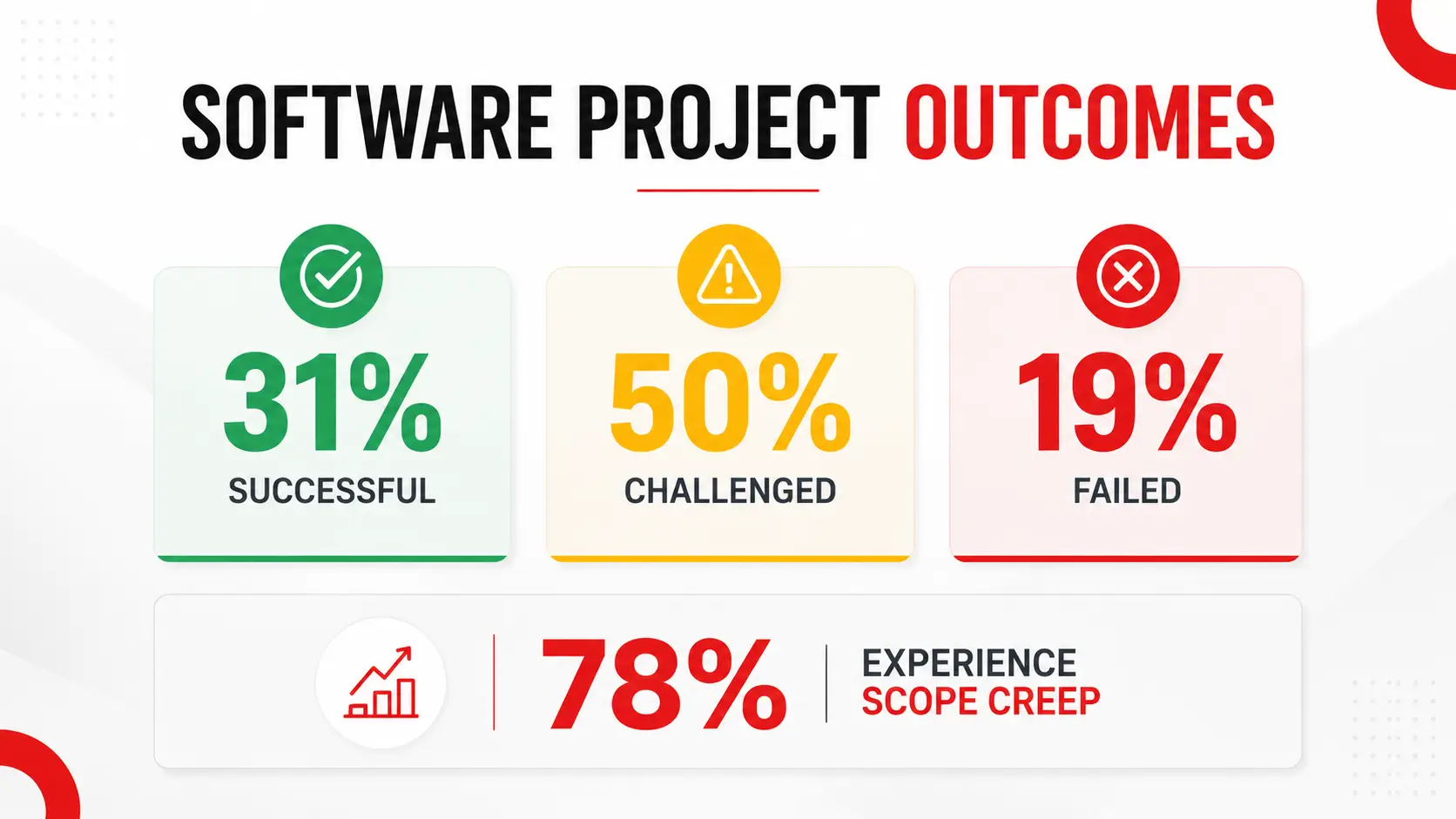
Only 31% of software projects succeed on time, on budget, and on scope (Standish Group CHAOS Report)
50% are challenged, meaning they launched but missed at least one major target
19% fail outright, either cancelled or never delivered
Large enterprise projects have less than 10% success rates
Small projects succeed roughly 90% of the time
78% of software projects experience scope creep (PMI)
52% of projects that experience scope creep see an average budget overrun of 27%
McKinsey found that 45% of large-scale IT projects run over budget, and 7% run over time
These numbers haven't improved much over the past two decades. The tools have changed, but the core problems remain the same.
7 Real Reasons Why Software Projects Fail
1. Unclear or Changing Requirements
This is the number one killer. Research shows that 50% of project failures stem from requirements issues, while only 7% come from actual coding errors.
When the people requesting the software can't clearly define what they need, the development team builds based on assumptions. Those assumptions compound over weeks and months until the final product looks nothing like what the business expected.
Equally damaging is when requirements keep changing mid-project. Every new feature request or quick addition pushes the timeline, inflates the budget, and forces the team to rework what's already built.
Real example: The UK's National Programmer for IT aimed to digitize the country's health records. The government underestimated the requirements and rushed the schedule. The project was eventually scrapped after costing taxpayers roughly £10 billion.
How to prevent it:
Document requirements thoroughly before any code is written
Get sign-off from all stakeholders before development starts
Use a formal change request process for any scope additions
Prioritize features by business value, not by who shouts loudest
2. Scope Creep
Scope creep is when new features, changes, or additions get added to a project without adjusting the timeline or budget. It's one of the most common reasons software development projects fail.
Over 70% of software and IT projects experience scope creep, according to the Standish Group. And it's rarely one big change that causes the problem. It's dozens of small ones. Each quick add feels harmless on its own, but together they can double the original project scope.
The result: the team is building twice the product with the same budget and the same deadline. Something has to give, and it's usually quality, timeline, or both.
How to prevent it:
Define a clear project scope in writing before development begins
Treat every new feature request as a formal change order with cost and timeline impact
Use an MVP approach: launch the core product first, then add features in future phases
Assign a single decision-maker who can approve or reject scope changes
3. Poor Project Management
A technically skilled development team can still fail without proper project management. When nobody is tracking progress, managing dependencies, or flagging risks early, problems compound silently until they become emergencies.
Common project management failures include:
No clear milestones or delivery checkpoints
No regular communication between the development team and stakeholders
Unrealistic timelines set by people who don't understand the technical work
No risk management plan for when things go wrong
Teams that rely on manual tracking or outdated tools are 28% less likely to deliver on time and 40% more likely to go over budget.
How to prevent it:
Break the project into clear phases with measurable milestones
Hold regular check-ins (weekly or bi-weekly) with all stakeholders
Use project management tools to track progress transparently
Assign a dedicated project manager who understands both the business and technical sides
4. Choosing the Wrong Technology or Architecture
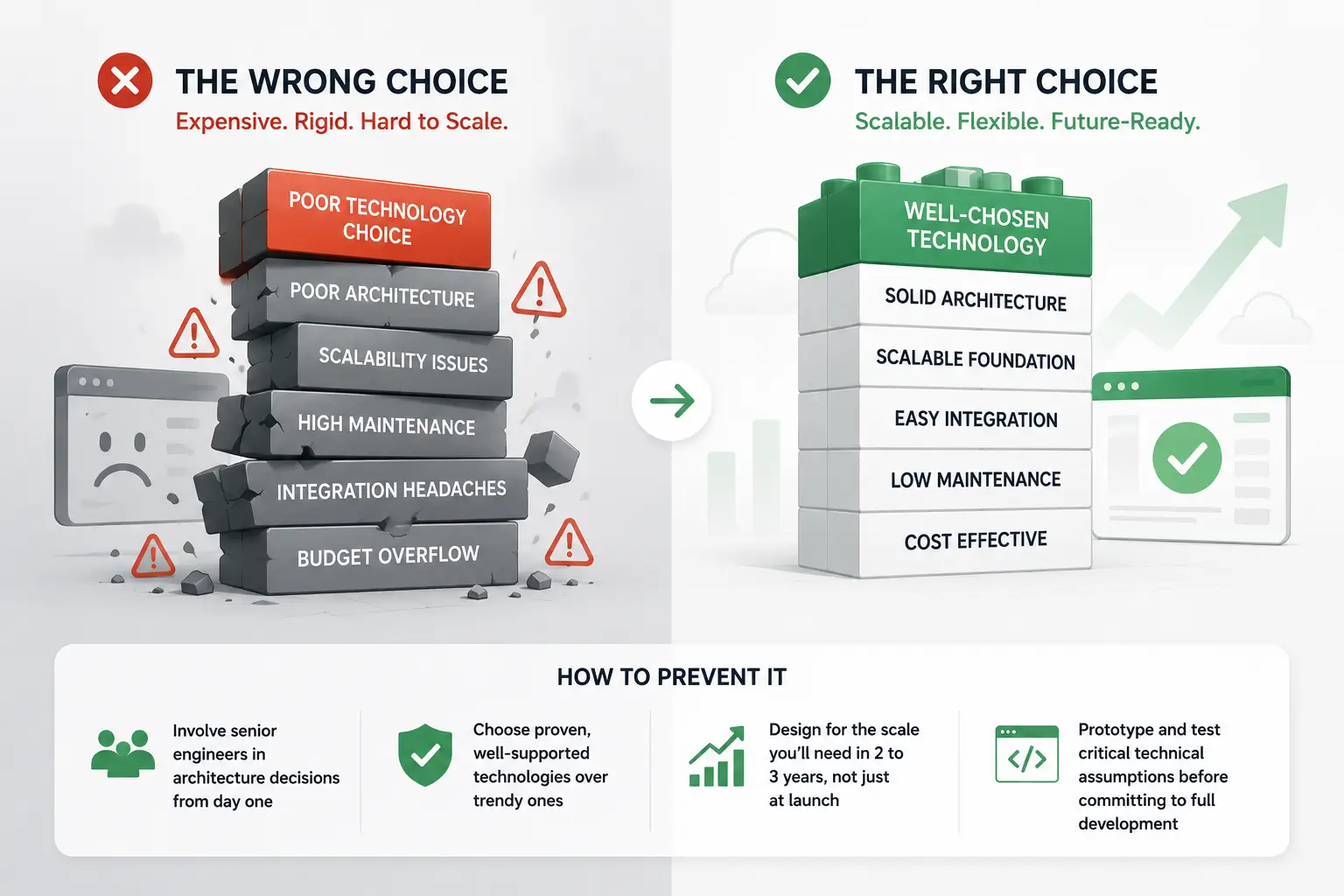
Technology decisions made in the first week of a project can haunt it for years. Choosing a framework because it's trendy, picking infrastructure that can't scale, or building a custom solution when an off-the-shelf tool would work better are all common mistakes.
Bad architecture decisions are especially dangerous because they're expensive to fix. By the time the team realizes the foundation is wrong, they've already built several layers on top of it. Fixing it means rebuilding, and rebuilding means blowing the budget.
Real example: The U.S. Air Force's Expeditionary Combat Support System (ECSS) attempted to modernize logistics through an enterprise ERP system. After spending $1.1 billion over several years, the project failed to deliver any usable functionality. Poor technical decisions and unresolved architecture issues were cited as primary reasons.
How to prevent it:
Involve senior engineers in architecture decisions from day one
Choose proven, well-supported technologies over trendy ones
Design for the scale you'll need in 2 to 3 years, not just at launch
Prototype and test critical technical assumptions before committing to full development
5. Lack of User Involvement
Building software without talking to the people who will actually use it is a guaranteed way to build the wrong thing. Yet it happens constantly.
The Standish Group identifies user involvement as one of the top three factors in whether a project succeeds or fails. When users are excluded from the development process, the team makes assumptions about workflows, priorities, and pain points that are often wrong.
The result is software that technically works but nobody wants to use. It doesn't match how people actually do their jobs, so they work around it, ignore it, or go back to the old system.
How to prevent it:
Include real end users in the discovery and requirements phase
Run usability testing at every major design milestone
Build a feedback loop where users can flag issues during development, not just after launch
Prioritize user experience alongside technical functionality
6. Unrealistic Timelines and Budgets
When leadership sets a deadline or budget based on business pressure rather than technical reality, the project is set up to fail from the start.
Developers under time pressure skip testing, take shortcuts in code quality, and push features live before they're ready. The project might hit its deadline, but the product is fragile, buggy, and expensive to maintain.
48% of projects fail due to lack of clarity in objectives, and unrealistic expectations are a major contributor. When the plan doesn't match reality, the project either misses its targets or delivers something that needs to be rebuilt almost immediately.
How to prevent it:
Let the development team estimate timelines based on actual scope, not business wishes
Build buffer time into the schedule for unexpected issues
Break the project into phases so you can launch a working product faster and iterate
Be transparent with stakeholders about trade-offs between speed, scope, and quality
7. No Testing or Quality Assurance
Skipping testing is one of the fastest ways to turn a functioning project into a failed software project. Without thorough QA, bugs slip into production, users lose trust, and the team spends more time fixing issues than building new features.
Testing isn't just about finding bugs. It's about verifying that the software actually does what the requirements specified. Without it, there's no way to know if the project has met its goals until real users start complaining.
Real example:Healthcare.gov launched on October 1, 2013, and immediately crashed under user load. End-to-end testing hadn't been completed until two weeks before launch. The site had not been thoroughly tested, and numerous software and hardware defects went undetected. The failed launch required months of emergency fixes and cost hundreds of millions in additional development.
How to prevent it:
Build testing into every sprint, not just at the end
Use automated testing for repetitive checks and regression testing
Conduct end-to-end testing well before the launch date
Include load testing to verify the system can handle real-world traffic
What Successful Companies Do Differently
Companies that consistently deliver software on time and on budget share a few common habits:
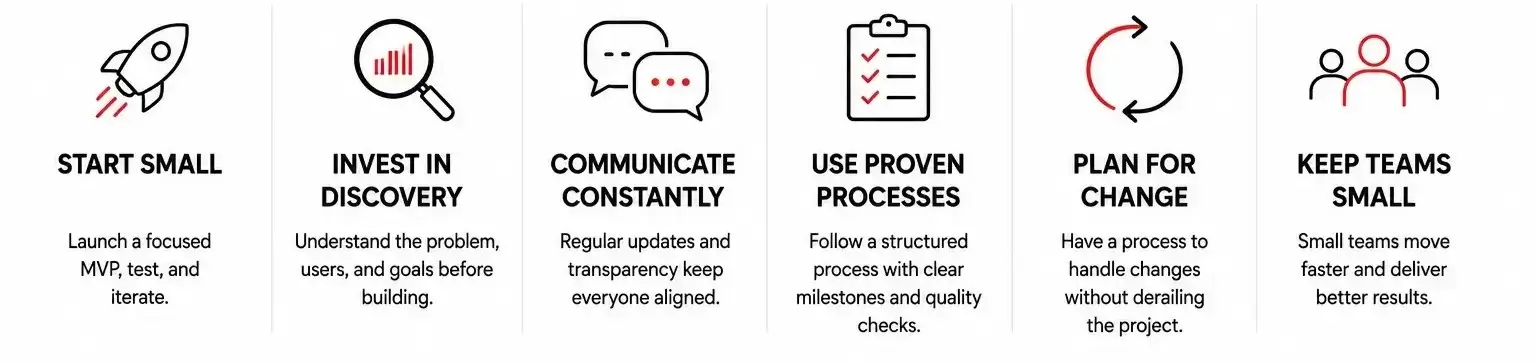
They start small. Instead of building the entire product at once, they launch a focused MVP with core functionality, test it with real users, and iterate from there. This reduces risk, gets feedback faster, and keeps the budget under control.
They invest in discovery. Before writing a single line of code, they spend time understanding the problem, the users, and the business goals. This upfront investment prevents costly pivots later.
They communicate constantly. Weekly check-ins, shared dashboards, and transparent progress updates keep everyone aligned. There are no surprises because nothing is hidden.
They use proven processes. Whether it's Agile, Scrum, or a hybrid approach, successful teams follow a structured delivery process with clear milestones, defined roles, and built-in quality checks.
They plan for change. Instead of pretending the scope won't change, they build in a formal process for evaluating and approving changes without derailing the project.
They keep teams small. Smaller teams move faster, communicate better, and produce higher-quality work. The Standish Group data confirms this: small projects succeed roughly 90% of the time, while large ones succeed less than 10%.
How to Know If Your Software Project Is at Risk
Watch for these warning signs:
Requirements are still changing after development has started
The team hasn't shown working software in more than 2 to 3 weeks
Stakeholders haven't seen the product since the initial mockups
The budget is more than 20% over the original estimate and climbing
The development team and business team aren't communicating regularly
Testing is being pushed to later to save time
Key decisions are being made by people who won't use the software
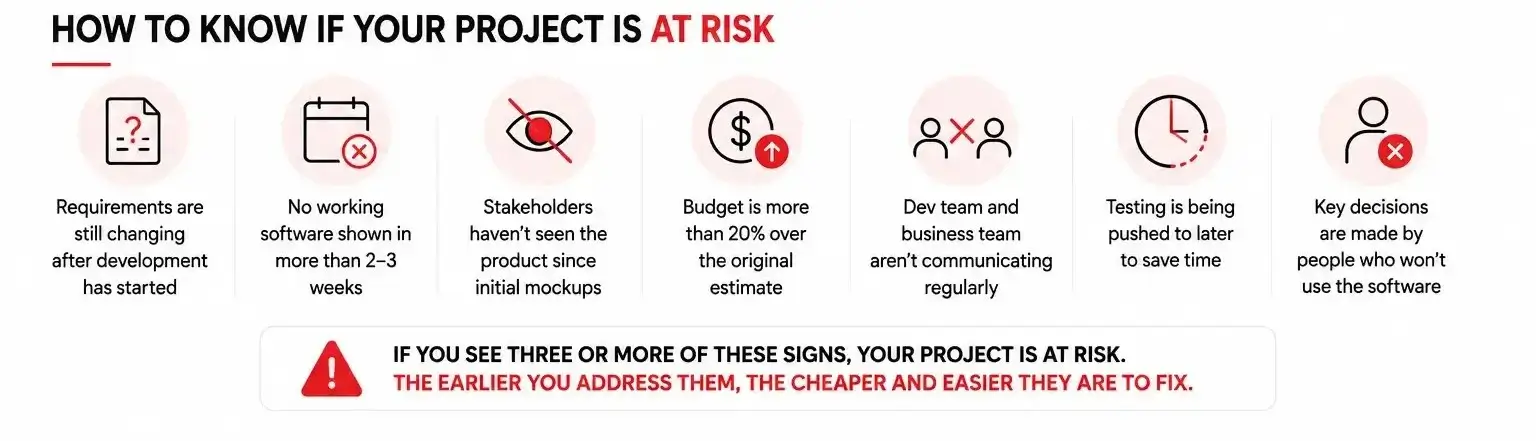
If you see three or more of these signs, your project is at risk. The earlier you address them, the cheaper and easier they are to fix.
Final Thoughts
Software project failures are not inevitable. The data is clear about why projects fail: unclear requirements, scope creep, poor project management, wrong technology choices, lack of user involvement, unrealistic timelines, and skipped testing.
The companies that consistently succeed aren't using secret tools or hiring ten times more developers. They're doing the basics well. They define what they're building before they build it. They communicate openly. They test early and often. And they stay disciplined about scope.
If you're planning a software project, the single best thing you can do is invest in proper discovery and planning before writing code. The upfront cost is small compared to the cost of building the wrong thing.
The 70% failure rate is an industry average. It doesn't have to be yours.