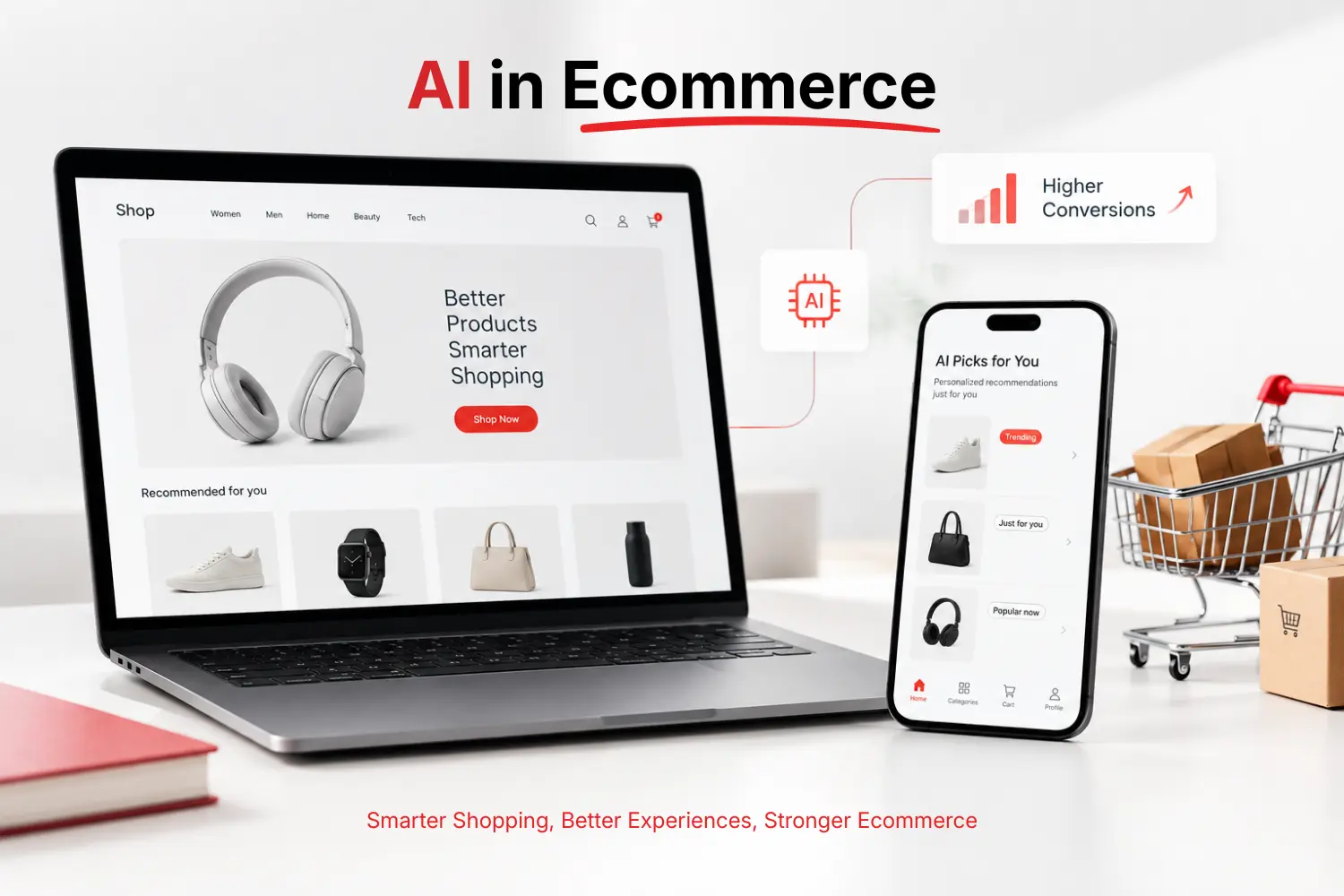
Shoppers no longer start with a search bar. Many now ask an AI tool what to buy, and some even let it complete the purchase. That is why artificial intelligence in ecommerce has moved from a nice extra to a core part of running a store. This guide covers what works today, the numbers behind it, and how to start without wasting budget.
What Is Artificial Intelligence in Ecommerce?
Artificial intelligence in ecommerce means software that learns from store data and uses it to make predictions or decisions. It studies what people click, search, buy and return, then acts on the patterns.
Three parts do most of the work:
Machine learning finds patterns in past data, such as which products sell together.
Natural language processing (NLP) lets software understand questions typed in plain words.
Generative AI writes text, answers questions and builds product content.
Together they power most of the AI e-commerce tools you already see, from "you may also like" rows to support chat.
Why AI in Ecommerce Is Growing So Fast
The link between AI and ecommerce now runs both ways. Shoppers use AI to find stores, and stores use AI to serve shoppers. Two forces are behind it.
First, shoppers are using AI to find products. Adobe Analytics found that traffic to US retail sites from generative AI tools grew 693% year over year during the most recent holiday season. Those visitors were also 33% less likely to leave right away. They arrive with a clear question, so they are often closer to a decision.
Second, shoppers expect a personal experience. McKinsey reports that 71% of consumers expect personalized interactions, and 76% get frustrated when they do not get them. Companies that do personalization well often see a 10 to 15% lift in revenue.
This is why AI in ecommerce is no longer just for big brands. Cloud tools have made it affordable for small and mid-size stores too.
7 Ways Artificial Intelligence in Ecommerce Is Changing Online Stores
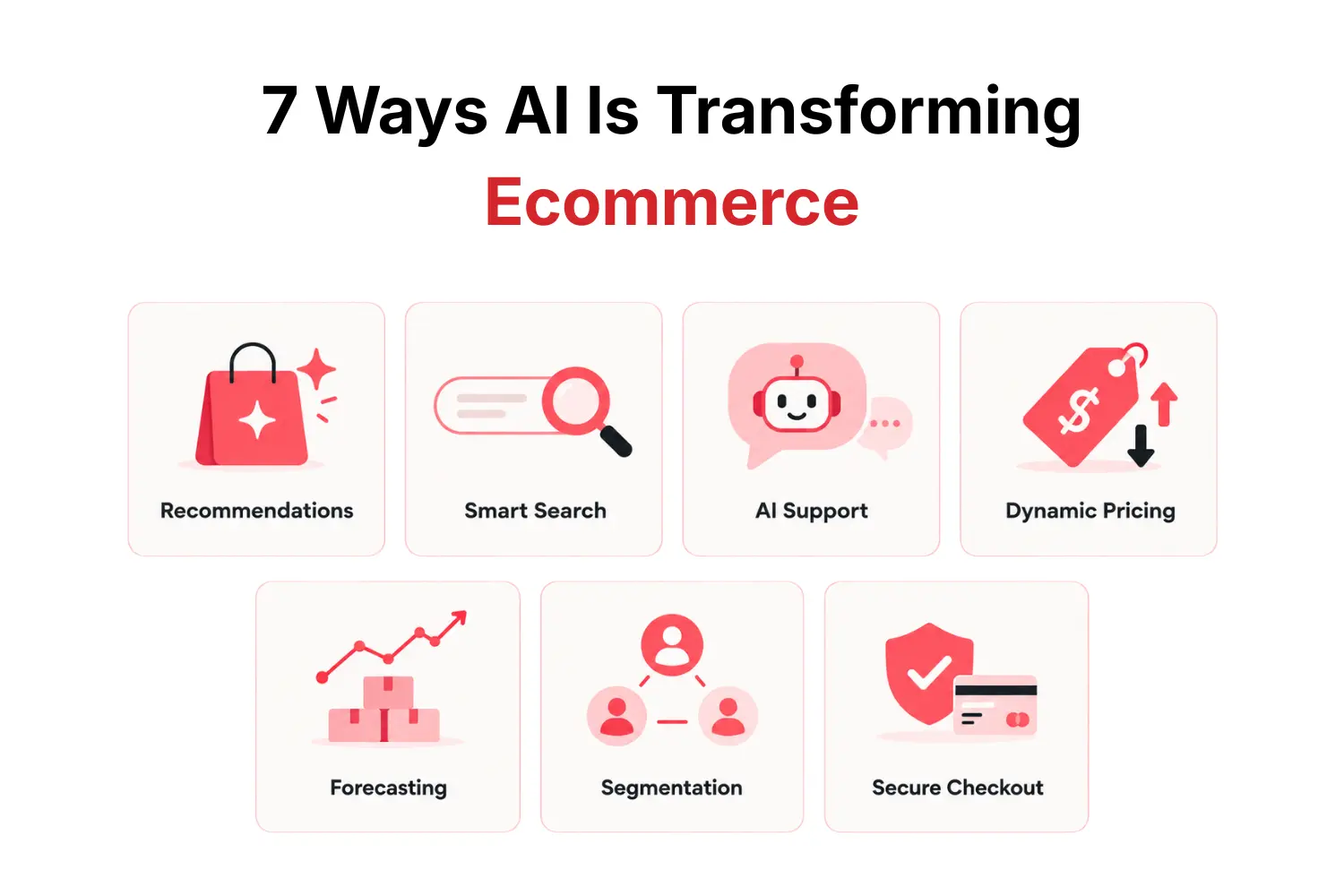
Here are seven uses of AI for ecommerce stores that deliver results today.
1. Personalized Product Recommendations
Recommendation engines compare your behavior with shoppers who look like you. A common method is collaborative filtering. If people who bought A also bought B, then B shows up for you. Newer models also read product text and images, so they can suggest items that have no sales history yet. That fixes the "cold start" problem for new products. The cart page and post-purchase emails are good places to test first, because the shopper is already in a buying mood.
2. Smarter Search and AI Shopping Assistants
Classic site search matches keywords. If a shopper types "shoes for a wet hike," a keyword engine may return nothing. Semantic search turns text into numbers called embeddings, so it can match meaning instead of exact words. AI shopping assistants build on this. They ask follow-up questions and narrow the choices in a chat. Finding the right item in a big catalog is a common frustration, and both tools help with it.
3. AI Chatbots and Customer Support
Modern support bots often use retrieval augmented generation, or RAG. The bot pulls answers from your own shipping, returns and product pages instead of guessing. That keeps replies accurate and on brand. A good setup also hands the chat to a human when the bot is unsure or the customer is upset. If you want to go deeper, read our guide on What AI agents are and how businesses use them.
4. Dynamic Pricing and Promotions
Pricing models look at demand, stock levels, competitor prices and the results of past discounts. They can suggest the smallest discount that still wins the sale. Set clear guardrails, such as a price floor and a limit on how often prices change. Shoppers notice unstable prices, and they react badly.
5. Demand Forecasting and Inventory
Forecasting is where AI often shows the clearest return. McKinsey research, summarized by Svitla, reports that AI can cut forecast errors by 20 to 50% and reduce lost sales from stockouts by up to 65%. The models blend sales history, seasons, promotions and outside signals such as search trends. Less overstock and fewer empty shelves both protect your cash flow.
6. Marketing and Customer Segmentation
Old segments are fixed lists. AI segments update as behavior changes. A customer who stops buying moves into a win-back group on their own. Predictive models can also score who is likely to buy again and who is likely to leave, so you spend ad and email budget on the right people. Our list of business automation tools shows how to connect this kind of scoring to your daily workflows.
7. Checkout and Fraud Detection
The Baymard Institute puts average cart abandonment at 70.22%, based on 50 studies. Not all of that can be fixed, because many people are just browsing. Still, Baymard estimates that better checkout design can lift conversion by 35.26% for a large store. AI e-commerce fraud tools help by spotting risky orders, so honest buyers face fewer blocks. Clean UI/UX design does the rest by removing extra steps and surprise costs.
What's New: Agentic Commerce and AI Shopping Agents
The biggest change is that AI is starting to buy, not just advise. This is called agentic commerce. A shopper tells an AI agent what they need, and the agent compares options and completes checkout. AI commerce is moving from chat to checkout, and artificial intelligence in ecommerce is entering a new stage because of it.
Two open standards lead the way:
Universal Commerce Protocol (UCP). Google and Shopify launched it, with partners such as Etsy, Walmart and Wayfair. It lets AI agents discover products and check out with a store, and it powers checkout inside Google's AI Mode and the Gemini app.
Agentic Commerce Protocol (ACP). OpenAI and Stripe built it, and it powers Instant Checkout in ChatGPT.
Shopify supports both through Agentic Storefronts, though it is still in early access, according to Shero Commerce. The two standards compete, so expect changes. For a custom store, the key task is the same either way. Your product, price, stock and checkout data must be available through reliable APIs. Commerce AI tools can only sell what they can read.
How to Get Found in AI Search
In AI commerce, your product data is your storefront. AI assistants recommend products they can read and trust. These steps help:
Add Product and Offer markup in JSON-LD, with price, availability, brand and reviews. The vocabulary comes from schema.org.
Fill every product feed field you can, including GTIN, size, color and material.
Keep price and stock in your feed the same as on the page. A mismatch gives agents a reason to skip you.
Write descriptions that answer real questions, such as who the product fits and what it does not do.
Common Challenges and Risks
The biggest risks of artificial intelligence in ecommerce are bad data, privacy gaps and weak oversight.
Artificial intelligence in e-commerce depends on clean data. A messy catalog gives messy results. Teams new to AI and ecommerce often skip this step and then blame the model.
Privacy comes next. Say clearly what you collect and why, and follow the laws that apply to you, such as PIPEDA in Canada and GDPR in Europe.
Generative tools can also write wrong or off-brand copy. Keep a human review step for anything customers will read. Finally, avoid big builds with no clear goal. They burn budget fast.
How to Start With AI Solutions for Ecommerce
The smartest way to adopt AI for ecommerce is to start small. Artificial intelligence in ecommerce pays off when it is tied to one clear number.
Pick one problem. Good examples are cart abandonment, support wait time or stockouts.
Clean the data behind it. Fix product attributes, duplicate records and missing fields first.
Test on a small slice of traffic. Compare the results with a control group.
Scale what wins. Then move to the next problem.
Many stores begin with ready-made ecommerce AI solutions and commerce AI apps. That works well until you need something specific to your catalog, such as a custom recommendation engine or an assistant connected to your own inventory data. At that point, custom AI solutions for ecommerce make sense. CanDev builds both AI systems and Shopify stores, and you can read how we think about AI in software development.
Tell us what you are building and we will suggest the best first step.