Every few months, a headline shows up claiming AI is about to replace software developers. Then a company announces layoffs and blames AI efficiency, and the headline gets shared another few thousand times.
Here's what the actual data says: AI is changing software development faster than almost any technology before it. But it isn't replacing developers. It's replacing the slow, repetitive parts of their job, and it's exposing which companies actually know how to use it well.
If you're a business owner deciding whether to invest in a new app, rebuild an old system, or hire a development partner, that distinction matters more than the headlines do.
AI adoption among developers is nearly universal now
According to the 2025 Stack Overflow Developer Survey, 84% of developers now use or plan to use AI tools in their workflow, up from 76% the year before. Daily and weekly use of AI coding assistants has become routine rather than novel.
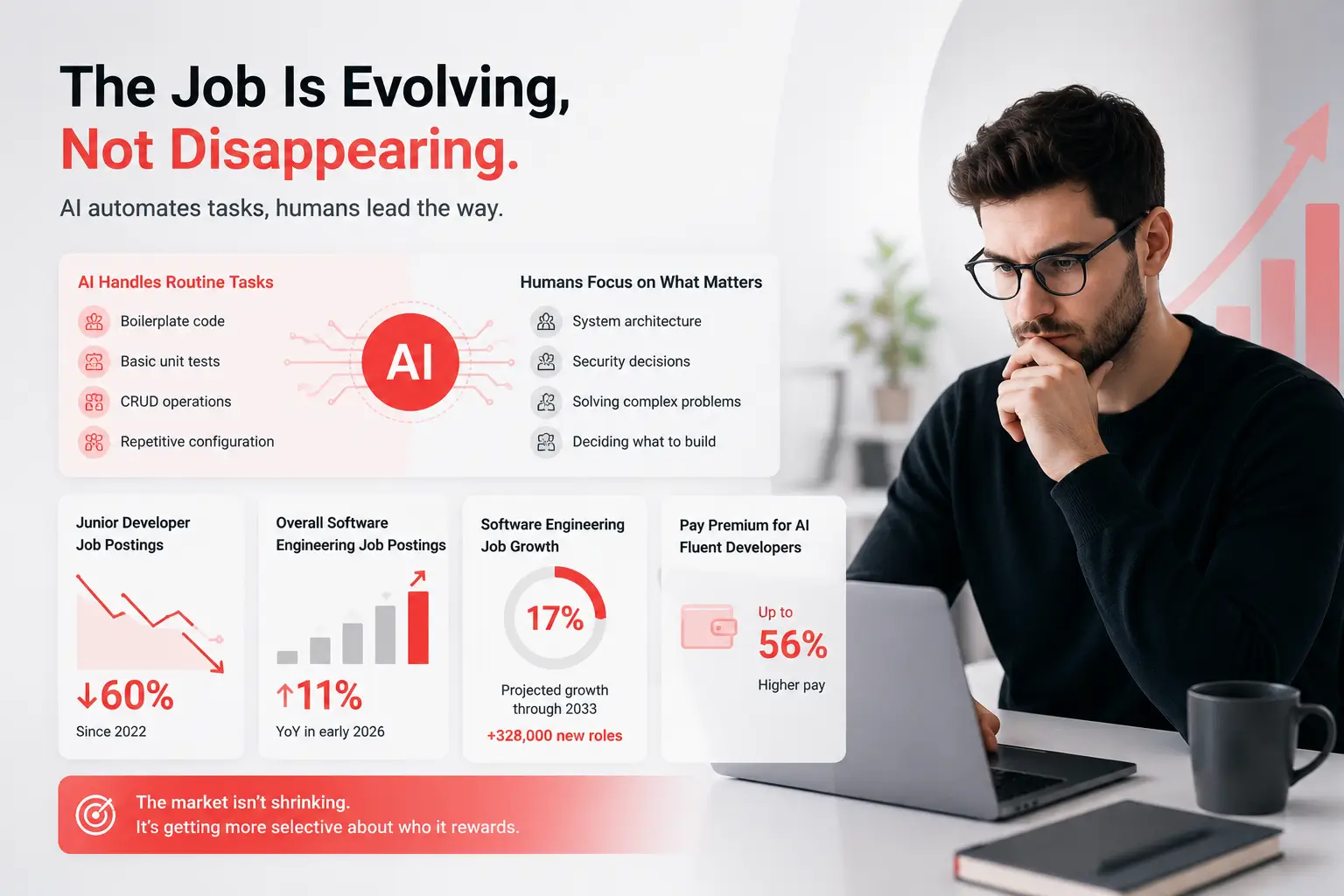
At the largest tech companies, AI-written code has moved from experimental to mainstream. Microsoft CEO Satya Nadella said in 2025 that 20 to 30 percent of code inside Microsoft's own repositories is now AI-generated. Google went further, reporting in 2026 that roughly 75% of new code was AI-generated and then reviewed and approved by human engineers, up from about 30% just two years earlier.
That's a real shift. But notice the second half of that Google sentence: reviewed and approved by human engineers. AI is writing more of the first draft. It is not making the decisions about what should ship.
The productivity story is messier than the hype
This is the part most AI will replace coders articles skip entirely.
A widely cited randomized controlled trial from METR tested what actually happens when experienced open-source developers use current AI tools on real codebases. The surprising result: developers were measurably slower, not faster, when relying on AI for these tasks, largely because verifying and correcting AI output took longer than expected.
Bain's research lands closer to the middle: real-world productivity gains from AI coding tools tend to run 10 to 15%, a meaningful improvement, but nowhere near the 10x developer claims used to sell some AI tools.
There's also a quality cost to moving fast. CodeRabbit's analysis of AI-generated code found it carries roughly 1.7 times more bugs than human-written code, and Stack Overflow's own survey found 66% of developers now spend more time debugging AI-generated code than they expected to. Developer trust reflects that reality: only 29% of developers say they trust AI output to be accurate, down sharply from 40% the year before.
None of this means AI isn't useful. It means AI is a powerful, imperfect tool that still needs an experienced person checking its work, which is exactly the role developers are moving into.
What's actually changing is the job, not the headcount
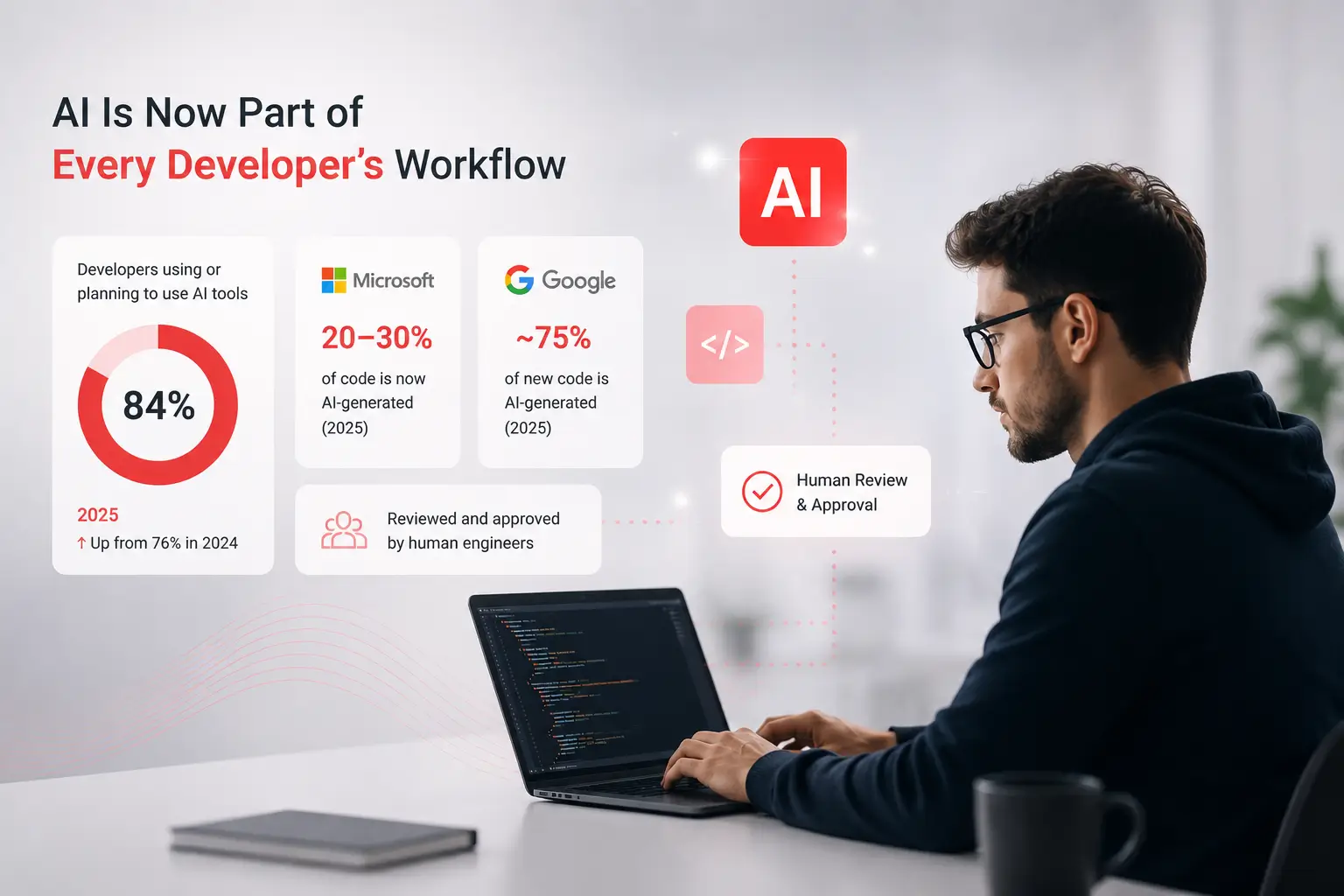
The clearest, most consistent finding across 2026 research is that AI is automating tasks, not occupations. Routine, well-defined work, like boilerplate CRUD operations, basic unit tests, and repetitive configuration, is increasingly handled by AI. The judgment-heavy work, system architecture, security decisions, debugging genuinely hard problems, and deciding what to build in the first place, still requires a human who understands the business behind the code.
That shift hits differently depending on where you are in your career. Junior developer job postings have dropped roughly 60% since 2022, largely because the entry-level tasks AI now handles were how junior developers used to learn the craft. At the same time, overall software engineering job postings are up 11% year over year in early 2026, and the U.S. Bureau of Labor Statistics still projects 17% growth in the field through 2033, adding roughly 328,000 new roles. Developers who are genuinely fluent in AI-assisted workflows are commanding pay premiums of up to 56% over those who aren't.
Put simply: the market isn't shrinking. It's getting more selective about who it rewards.
Why this matters if you're hiring a development team, not writing code yourself
If you're evaluating a software partner in 2026, the AI conversation should change one thing about how you choose: ask how they actually use it.
A team that lets AI write unreviewed code straight to production is optimizing for speed over your product's stability, and the bug-rate data above shows exactly what that trade-off costs. A team that uses AI to accelerate the repetitive parts of development, while keeping architecture, security, and code review firmly in human hands, is using the technology the way the research actually supports.
That's the model we use at CanDev. We build AI into how we deliver work, speeding up testing, documentation, and repetitive coding tasks, and we build AI features directly into client products when they add real value. But every architecture decision, every security review, and every line that ships to production still goes through an experienced engineer, because that's the part of the job the data says still matters most.
AI didn't end software development. It raised the bar for what "good" looks like, and it's making the gap between teams who use it well and teams who don't a lot easier to see.