In 1993, a cognitive scientist named Don Norman gave himself a job title nobody had used before: User Experience Architect. He was working at Apple at the time, and he later explained that usability and human interface felt too narrow for what his team actually did. They weren't just designing screens.
They were shaping how a person felt using the whole product, packaging, manual, and all. That one made-up job title is basically the reason we're still arguing about UX versus UI more than thirty years later.
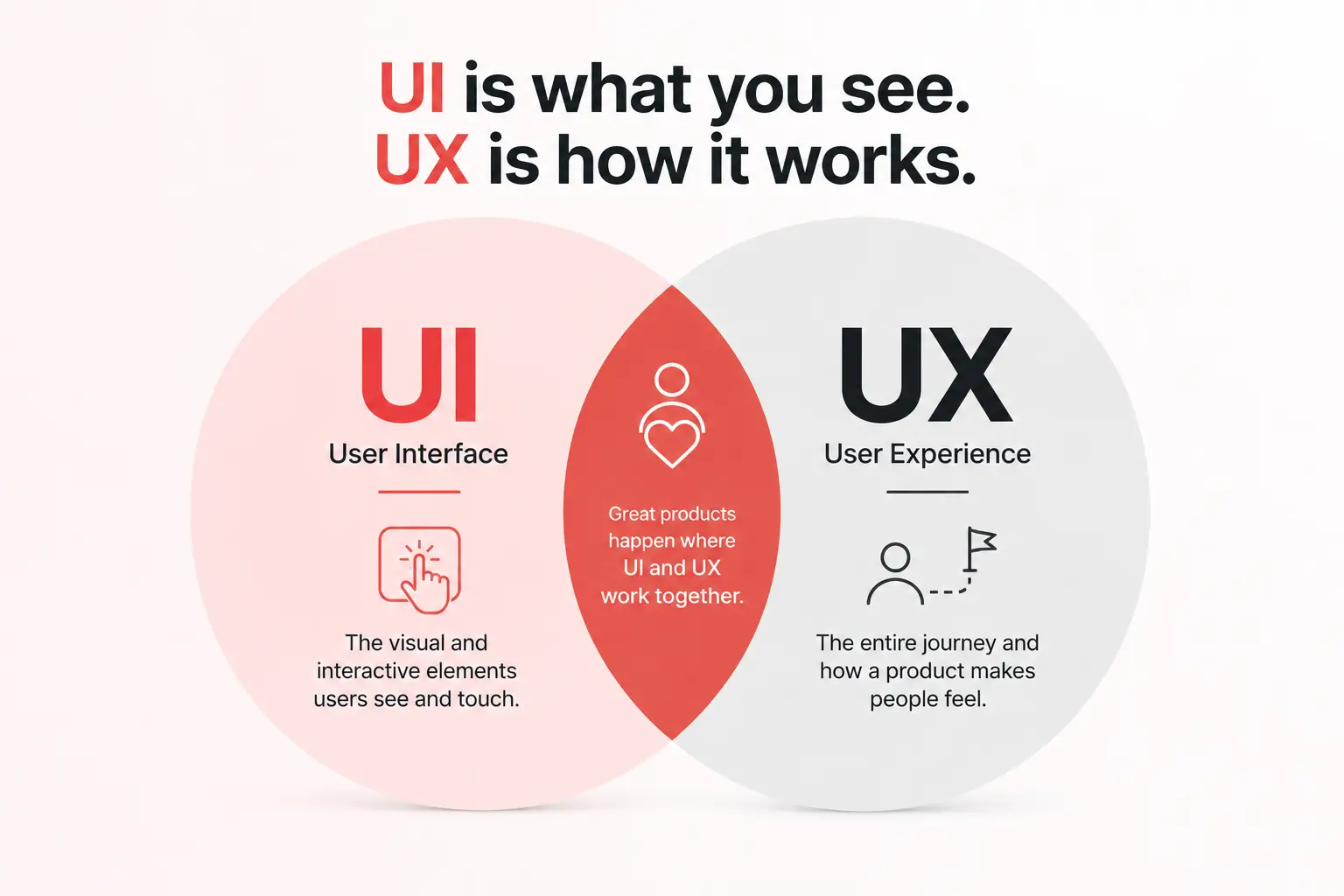
Here's the short version. User interface is what you see and touch: the buttons, the colors, the layout, the icon you tap to open an app. User experience is everything around that: whether the product actually helped you do what you came to do, and how you felt while doing it. UI is part of UX. It's not the whole thing, and mixing the two up is how a lot of companies end up with a gorgeous app that nobody can actually use.
That sounds simple enough until you're hiring for one of these roles, or staring at a beautifully designed app with a two percent conversion rate and no idea why.
Where the Term "User Experience" Actually Came From
Norman didn't invent the idea of designing for people. Industrial designers and ergonomists had been doing that for decades. What he did was give it a name broad enough to cover the entire relationship between a person and a product, not just the screen in front of them.
In 1998, Norman teamed up with Jakob Nielsen, another major figure in usability research, to form the Nielsen Norman Group, which is still one of the most cited authorities in the field today. Their work is a big part of why user experience grew from an Apple job title into an entire industry with its own job boards, bootcamps, and conference circuit.
Knowing this history actually matters, because it explains why UX was never meant to be about screens at all. It's about the whole journey, and the interface is only the part you can point at.
What User Interface (UI) Actually Means
UI is the visual and interactive layer of a product. Buttons, icons, typography, spacing, color, the little animation that plays when you pull to refresh. It's everything you can literally point your finger at.
A good UI designer thinks about consistency (does every button in your app behave the same way), hierarchy (does your eye land on the right thing first), and clarity (can someone tell what's clickable without guessing). Instagram's interface is a good example. The icon grid, the consistent tap targets, the way stories are visually separated from the feed. None of that happened by accident.
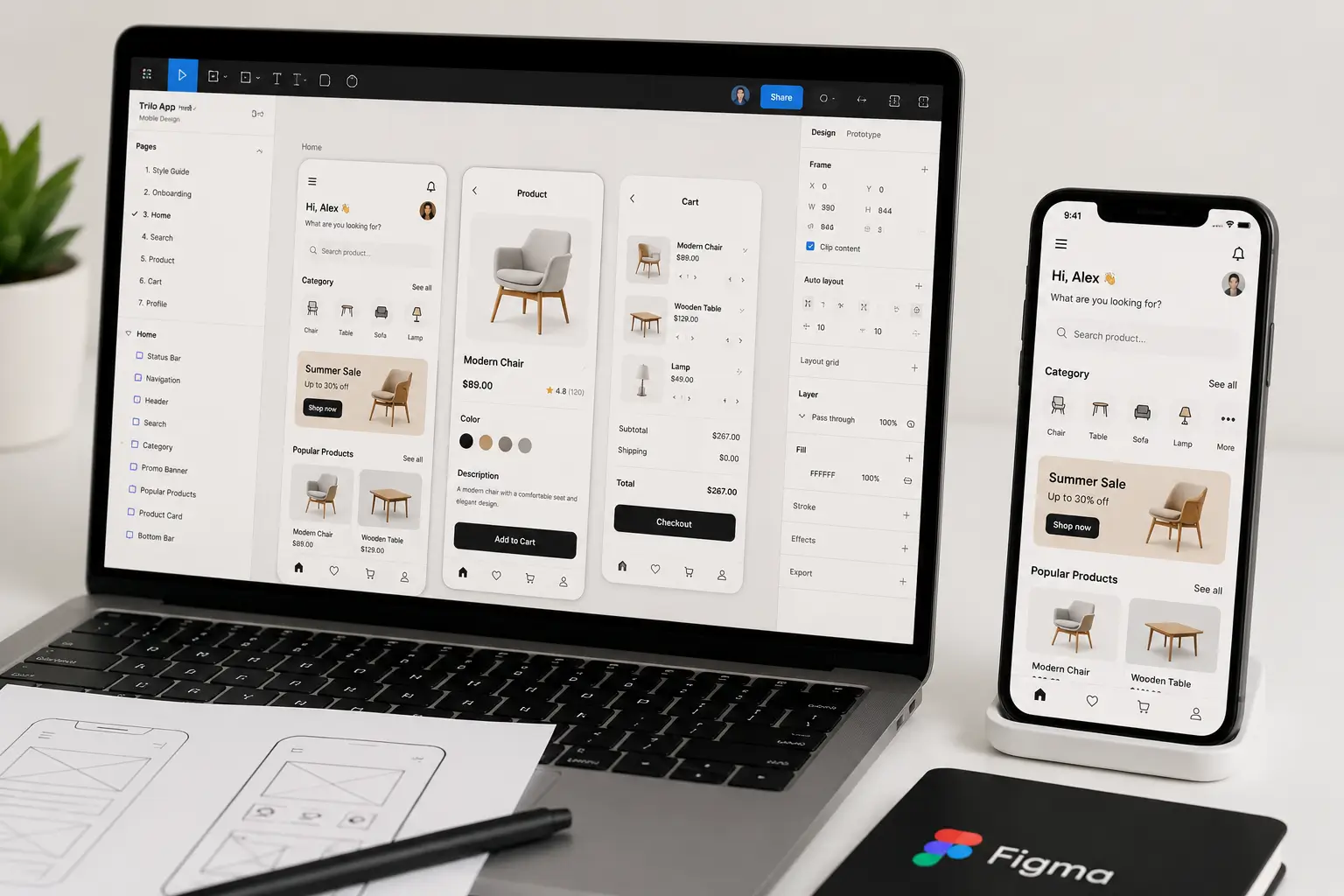
Most UI work today happens in tools like Figma, which lets designers build and test interfaces before a single line of code gets written.
What User Experience (UX) Actually Means
UX is bigger and messier. It covers research (who's actually using this and what are they struggling with), information architecture (how is content organized so people can find it), user flows (what's the path from opening the app to completing the goal), and testing (does this actually work for real people, not just the designer who built it).
A UX designer might spend a week doing user interviews before a single screen gets designed. They're the ones asking why does our checkout have five steps when three would work, long before anyone worries about what color the button should be.
The Core Difference, Shown With One Real Example
Take Google Search. The UI is about as minimal as it gets: a white background, one input field, clean type. There's barely anything to look at. But the UX is some of the most refined in software history, because the entire journey (type a question, get an answer, done) has been optimized for over two decades.
Now flip it. Picture a banking app with a beautiful dark mode, smooth animations, and a genuinely elegant layout. Great UI. But if a user opens it to send money to a friend and can't find that option without digging through three sub-menus, the UX has failed even though the UI looks great. We've seen this exact scenario with clients before: a visually stunning first draft that tested terribly the moment real users tried to complete a basic task.
Is UX More Important Than UI, or Is It the Other Way Around?
Neither, honestly, and this is one of the most common questions people search for an answer to. They're not competing disciplines. They're solving different problems.
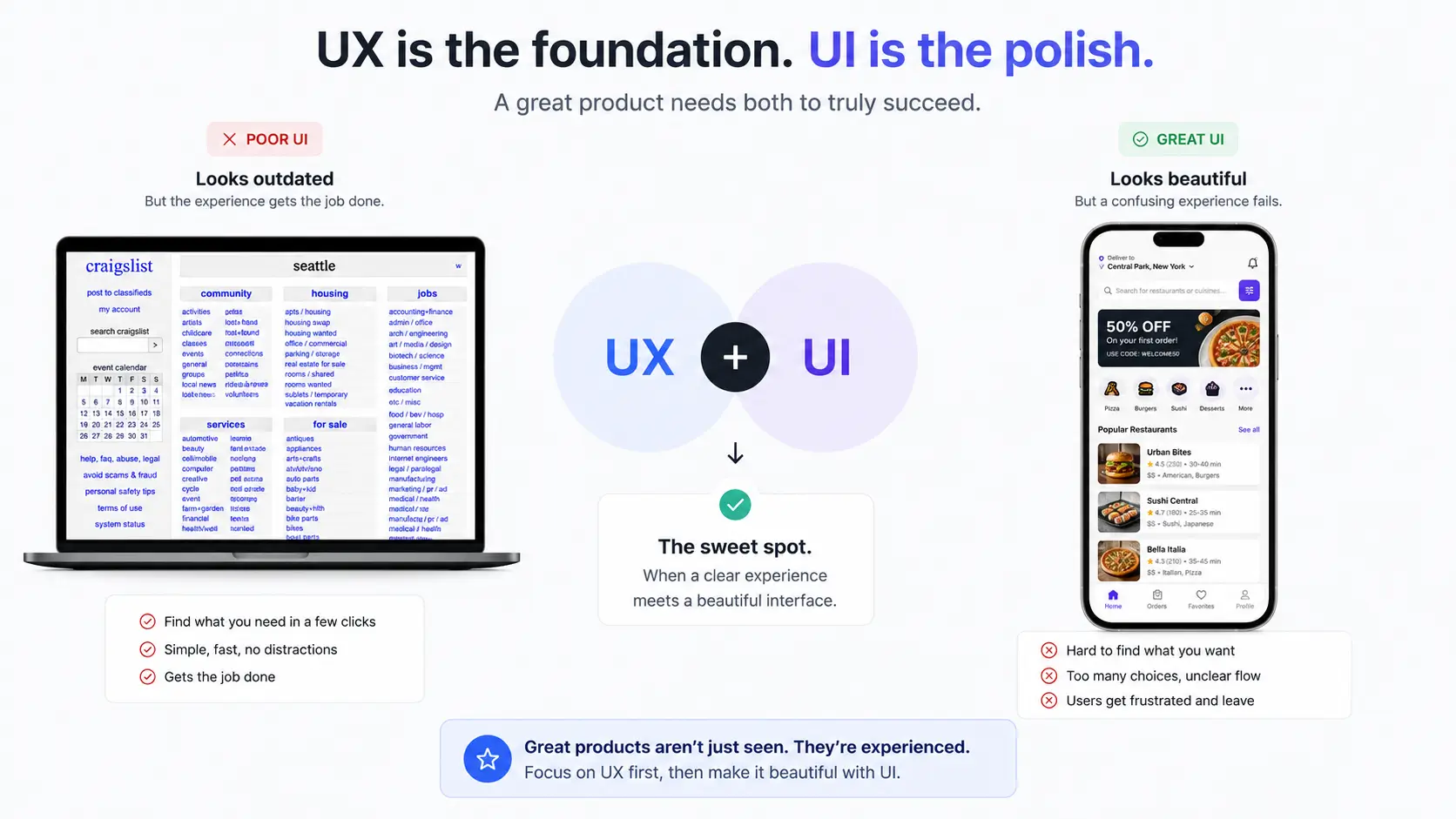
Craigslist is the classic counter-example. The UI has barely changed since the 2000s, and by most design standards it's ugly. But the UX works: you can find an apartment or sell a couch in about four clicks, which is why people keep using it despite how it looks. On the flip side, plenty of apps with stunning interfaces fail because nobody thought through whether the core task actually made sense.
If you had to pick one to get right first, it's UX. A product with a rough interface but a clear, working journey will usually outperform a gorgeous interface wrapped around a confusing one. But you don't actually get to pick just one for long. Users notice both.
How UI and UX Designers Actually Work Together, Day to Day
On a real project, UX usually comes first. Research, then wireframes (rough, low-detail sketches of layout and flow, no colors or fonts yet), then a tested user flow. Once that skeleton is solid, UI design adds the visual layer: colors, typography, spacing, a design system so every screen feels like it belongs to the same product.
Then it gets prototyped, usually in Figma, and tested again with real users before a developer touches it. Smaller teams and startups often hire one person to do both, and that's fine for simpler products. Larger products usually split the roles, because deep user research and pixel-level visual design are genuinely different skill sets, even though they aim at the same goal.
Skills, Tools, and Where People Specialize
UX-focused designers tend to be strong in research methods, user testing, and information architecture. UI-focused designers tend to be strong in visual design, typography, and interaction detail. Both usually work in Figma these days, with some teams still using Sketch or Adobe XD.
If you're hiring, don't assume UI/UX designer on a resume means someone is equally strong at both. Ask to see examples of their research process, not just the final screens. The final screens are the easy part to fake.